

How to Push Down Negative Search Results (Free & Paid Methods)
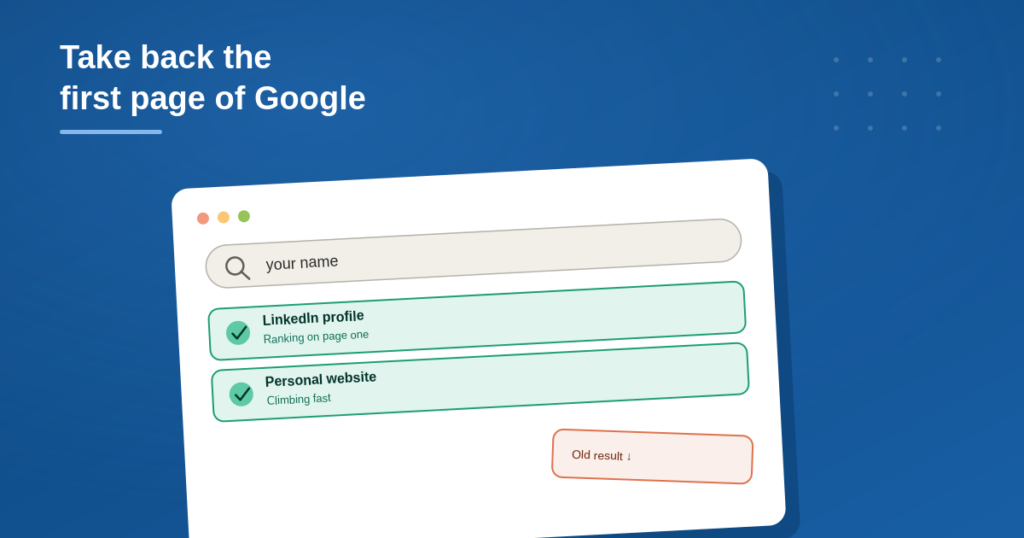
You can push down a negative search result without paying anyone, and here are three ways to start today: publish a fresh LinkedIn or About.me profile optimized for your name, write a guest post or article on a high-authority site like Medium or Quora, and ask any site hosting outdated or false content for a takedown. None of these cost money, they just cost time, consistency, and a bit of patience.
That last part matters. Free methods work, but they’re slow. If you need results in days rather than months, there’s a faster path too, more on that below.
Here’s the full breakdown of what works, what doesn’t, and how long each approach realistically takes.
Why Negative Results Appear at the Top of Google
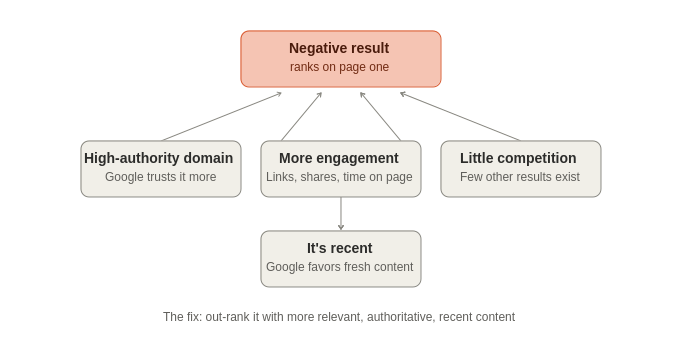
Before fixing the problem, it helps to understand why it happened. Google ranks results based on relevance, authority, and engagement, not fairness. A few common reasons a negative result outranks everything else about you:
- The negative content is hosted on a high-authority domain (a major news site, a mugshot aggregator, a popular forum) that Google already trusts more than your personal website or social profiles.
- It has more backlinks or engagement than anything else with your name attached, shares, comments, and time-on-page all signal relevance to Google.
- You don’t have much else online. If your name returns five results total and one is negative, that one result dominates a much smaller pool of competition.
- It’s recent. Google tends to favor fresher content, so a negative story from last month can outrank a positive profile from three years ago, even one with more authority.
The fix, in every case, comes down to the same principle: give Google more relevant, authoritative, and recent content about you than the page you’re trying to push down.
Free Methods to Push Down Bad Search Results
These won’t cost you anything but your time. Done consistently, they work, the catch is the timeline, which we’ll get to after.
Create New Positive Profiles (LinkedIn, About.me, Crunchbase)
Profile pages on high-authority platforms rank well almost by default, because Google already trusts the domain. Three worth prioritizing:
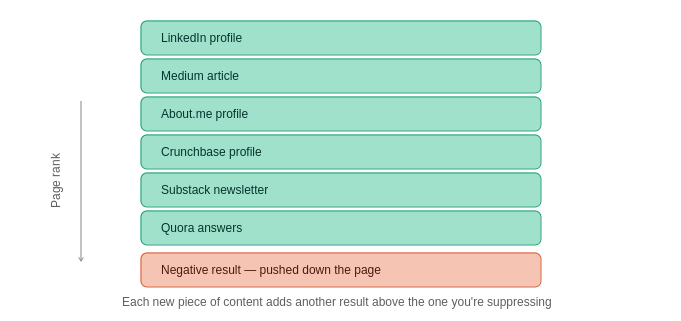
- LinkedIn — a complete profile (photo, headline, summary, experience, skills, recommendations) with your full name in the headline and URL slug tends to rank on page one for most names within weeks.
- About.me — a single-page profile that’s fast to set up and indexes quickly; good for consolidating links to your other positive profiles in one place.
- Crunchbase — especially useful if you’re a founder, executive, or work in a startup-adjacent field; it carries strong domain authority and often ranks high for name searches.
The key isn’t just creating these, it’s filling them out completely. A half-finished profile with no photo and one line of text won’t out-compete a detailed news article.
Publish Fresh Content on High-DA Platforms
Google rewards content that’s both authoritative and current. Writing and publishing your own content under your name on well-established platforms gives you a controllable, ownable asset that can rank for your name search.
This works best when the content is genuinely about your work or expertise, a project breakdown, an opinion piece, an explainer in your field, rather than generic filler. Search engines and readers can both tell the difference.
Leverage Medium, Substack, Quora
These three platforms deserve a category of their own because they combine high domain authority with low barriers to publishing:
- Medium — publish under your real name, use your name naturally in the title or subtitle, and link back to your other profiles. Medium articles often rank within days to weeks for less competitive names.
- Substack — works well if you can commit to a few posts rather than one; an active newsletter under your name builds a stronger, more sustained footprint than a single article.
- Quora — answering questions related to your field, with your real name and a complete profile, creates additional indexed pages associated with your name. It’s lower effort per post than Medium or Substack and a quick supplement.
None of these work in isolation as a single post and done. The cumulative effect of several pieces across several platforms, each linking back to one another, is what actually shifts rankings.
Why Free Methods Take 6–12 Months
This is the part most guides skip. Free suppression works, but slowly, for a few structural reasons:
- New content needs time to earn authority. A brand-new LinkedIn profile or Medium post doesn’t outrank an established news article on day one — it has to accumulate the engagement, backlinks, and indexing signals that took the negative result months or years to build.
- You’re doing this without paid promotion. Without backlinks, social shares, or any distribution push, new content relies entirely on organic crawling and slow authority accumulation.
- Consistency is hard to sustain alone. Suppression isn’t a one-time project, it requires regular publishing across multiple platforms over months, which is where most DIY efforts stall out after the first few weeks.
- You’re competing with established content, not starting from zero. The negative result already has a head start in age, links, and engagement.
None of this means free methods don’t work, they do, and plenty of people successfully push down negative results entirely on their own. It just means you should plan for a 6–12 month timeline, not a 6–12 day one.
How Professional ORM Accelerates Suppression to 30–90 Days
Online reputation management (ORM) services compress that timeline by doing, in parallel and at scale, what a single person does slowly alone:
- Simultaneous multi-platform publishing instead of one post at a time, building several high-authority assets in the same week rather than spreading them across months.
- Strategic backlinking and promotion to new content, which speeds up how quickly Google indexes and trusts it, rather than waiting on organic discovery alone.
- Direct removal requests run in parallel with suppression, pursuing takedowns with webmasters, DMCA claims, and de-indexing requests at the same time new content is being built, rather than choosing one approach at a time.
- Ongoing monitoring, so the work doesn’t stall after the first push, most DIY efforts lose momentum after a few weeks, which is exactly when results plateau.
This is the tradeoff: free methods cost time, professional ORM costs money, and both can get you to the same outcome. If your timeline is flexible, you’re not facing an active job search, deal, or relationship decision riding on it, the free route is a completely reasonable place to start. If you need it resolved in weeks rather than the better part of a year, that’s the gap professional suppression is built to close.
If you want a clearer picture of what that looks like for your specific situation, our Personal Reputation Management page breaks down the full process, realistic timelines, and what’s actually removable versus what requires suppression.
DIY vs. Professional: Timeline Comparison
| DIY (Free) | Professional ORM | |
|---|---|---|
| Timeline | 6–12 months | 30–90 days |
| Cost | $0 (your time only) | Paid service |
| Approach | Sequential, one platform at a time | Parallel — multiple platforms + removal at once |
| Promotion | Organic only | Backlinking & strategic promotion |
| Monitoring | Manual, often inconsistent | Ongoing, built into the service |
The Bottom Line
Pushing down a negative search result is almost always possible, the real question is how much time you have. Free methods (LinkedIn, About.me, Crunchbase, Medium, Substack, Quora, and consistent fresh content) work reliably over 6–12 months. If you need faster movement, professional reputation management can compress that into 30–90 days by running removal and suppression in parallel instead of in sequence.
Not sure which path fits your situation? Start with our free reputation audit, it’ll show you exactly what’s realistic, free or paid, for what’s currently ranking about you.
